
The $56M Cocoa Station Myth: Bringing Federal Cash Home to a Crumbling Business Model
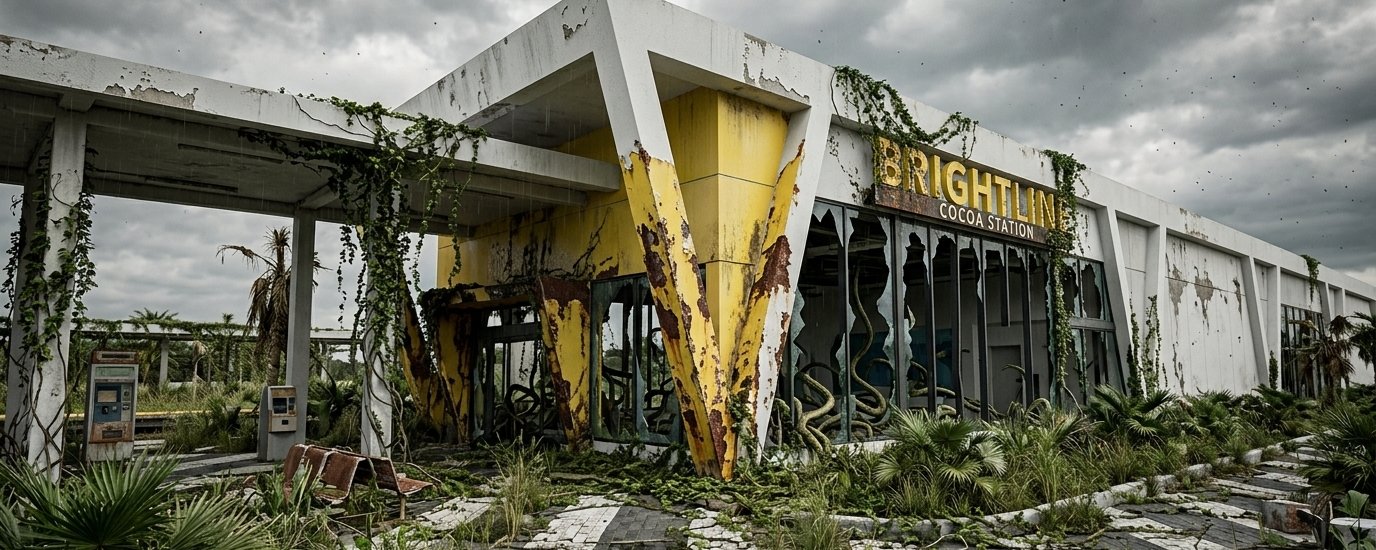
Congress brought the money home. That is what members of Congress are elected to do.
On August 11, 2026, Congressman Mike Haridopolos announced that the Federal Railroad Administration awarded $57.5 million to the Cocoa Brightline Station project. The praise was immediate. The press release framed it as an investment in transportation infrastructure, jobs, and a brighter commuting future for Florida’s Space Coast.
But when you look beyond the ribbon-cutting rhetoric, the math tells a very different story — one that raises serious questions about who is actually paying for this dream, and whether the project can ever succeed on its own merits.
Let’s be clear about what that money is supposed to do.
The $57.5 million federal grant is part of a much larger $80 million funding package for the Cocoa station. That package includes a $20 million state contribution from the Florida Department of Transportation and a $2.5 million local match from the City of Cocoa. Together, these grants are marketed as a transformative investment that will create jobs, ease traffic congestion, and connect the Space Coast to Florida’s growing passenger-rail network.
The press release paints a glossy picture. The reality is far more concerning.
First, consider the timing. This grant arrives at a moment when Brightline, the private rail company behind the project, is facing severe financial challenges. And not minor ones — we're talking about default-level credit ratings, a mountain of debt, and a business model that has yet to prove it can stand on its own two feet.
Brightline still carries 'CCC' default ratings and $2B+ in debt. Will taxpayers soon be the next owner of a failed rail operation?
A Train Wreck in Financial Terms
The core problem is simple: Brightline's financial footing is deeply unstable.
In October 2024, Fitch Ratings downgraded Brightline's debt to 'CCC,' a rating reserved for companies at high risk of default. Earlier, S&P Global Ratings took a similar step, cutting Brightline's rating from 'CCC+' to 'CCC-' — one notch above default, in financial terms.
That same month, Brightline's own bond documents conceded that its earnings in 2023 were insufficient to cover its interest payments by a significant margin. In other words, the company is already struggling to meet its debt obligations, even before it takes on the additional costs of building and operating a new station in Cocoa.
An $80 million grant to a company in this condition is not an investment; it's a lifeline. And like any lifeline thrown to a sinking ship, it only delays the inevitable if the vessel isn't made seaworthy.
Not Their First Rodeo in Cocoa
Brightline has a history of ambitious plans that fizzle out. In 2018, it announced a Cocoa station. In 2022, it promised the station would open by 2026. Now, four years after the initial pitch, the company is back at the federal trough, this time asking taxpayers to pick up the check.
That's not a history of delivering on promises. It's a pattern of grand pronouncements followed by delays, and now, an outright appeal for public money to bail out a private venture.
This isn't about a lack of ambition. It's about a company that has repeatedly failed to deliver on its commitments, and is now asking the public to shoulder the burden of its failure.
The question is no longer whether the Cocoa station will be built — it's whether taxpayers should have to pay for it.
The Question No One Is Asking
When Haridopolos announced the $57.5 million federal grant, he praised it as bringing home federal dollars for economic development. But he failed to address the elephant in the room — the nearly $80 million price tag is a rounding error compared to what this project will ultimately cost.
Let me be direct: This is the Cocoa station. If we learned anything from Central Florida's history with rail, it's that the initial grant is just the beginning. Once the station is built, the costs don't stop. Who pays for the station's ongoing operations? Who pays for maintenance, staffing, security, and the inevitable cost overruns? I’m not seeing any answers — just the promise of a station that may or may not ever turn a profit.
And that's just the beginning. The real cost — the one that taxpayers will bear long after the ribbon is cut — is the future liability.
If the station fails, taxpayers will be left footing the bill. If it succeeds, they'll be told it was a wise investment. Either way, the public takes the risk while Brightline reaps the reward.
A Failure of Leadership in Congress
Haridopolos may have 'brought home the money,' but at what cost?
If this project were a private venture that had asked for taxpayer dollars, we would subject it to rigorous scrutiny. And that scrutiny would quickly reveal the truth: Brightline is a company with a deeply flawed business model, massive debt, and a track record of broken promises. It's not a company that should be receiving public money — it's a company that should be facing hard questions about its viability.
The fact that a member of Congress is celebrating this as a victory is a failure of leadership.
The hard truth is this: repeat business with failing companies requires different thinking. We cannot keep rewarding failure with public money, hoping that this time, the outcome will be different. Haridopolos may see this as a win. But to a clear-eyed observer, it looks less like a victory and more like a blueprint for yet another failure.
The real tragedy is that the people of Florida — the very people this station is supposed to serve — will be the ones left holding the bag when this project inevitably falters. They'll bear the costs of a station built on a shaky foundation, of a private company propped up by public money, and of a political class that seems more interested in ribbon-cuttings than in results.
The Bottom Line
Bringing home federal money is not a win in and of itself — especially when that money is being handed to a company that continues to show no credible path to profitability. Before we declare victory, we should be asking harder questions — about the company's financial health, its ability to execute, and the long-term risk to taxpayers.
Let's be clear about this: $57.5 million in federal grant money is not an investment in transportation. It is a risk. And until we see that risk balanced against genuine accountability, this grant is a story of political failure — not of progress.
We deserve better than another flashy announcement followed by the same old story. We deserve leadership that digs deeper, demands answers, and holds failing companies to a higher standard. Until that happens, on this one — no amount of ribbon-cutting will change the underlying reality. Let's stop funding failure, and start leading — until we do.