
Amendment 3 Flipped Palm Bay's Zoning Math, and It Does Not Flip Back
I have spent thirty years watching Palm Bay fight about growth, and the fight never changed. Neighbors pack the council chambers to kill apartments. Single-family subdivisions get treated as the good kind of growth. City Hall listens to the room.
On November 3, Florida voters changed the math underneath that fight, permanently. Nobody on the dais is going to announce what it means. They won't have to. You will see it in what sails through and what suddenly hits friction.
Here is my rule, and I'll say it plainly: It doesn't make sense for the city to zone or make land use changes to properties that would or could be homesteaded.
Amendment 3 changed the arithmetic of every land-use decision the city makes. A new owner-occupied subdivision adds service costs to the general fund and pays a shrinking share of city property tax to cover them. For the typical established home, that share is nothing.
Apartments, retail, warehouses, hotels, and corporate-owned rentals get no homestead exemption. They enter the roll at uncapped 100 percent taxable value. That is the inversion, and the rest of this column is the proof.
The rule that changed
Before Amendment 3, a Florida homestead got a $25,000 exemption plus a second, inflation-indexed exemption ($26,411 on the 2026 roll) that applied only to value above $50,000. The slice between $25,000 and $50,000 stayed taxable on every home. Every homestead paid the city something.
Amendment 3 deletes that structure for city and county taxes. It replaces it with one flat exemption from the first dollar of assessed value. For anyone who was a Florida resident on December 31, 2026, it is $150,000 on the 2027 roll and $250,000 on the 2028 roll. After that it is indexed to CPI every year. The state's estimators project $255,600 in 2029, $260,993 in 2030, and $267,231 in 2031.
Newcomers get $50,000 plus inflation for four years, then graduate to the full amount in year five. School taxes keep the old $25,000. The amendment took 61.99 percent statewide and 61.00 percent in Brevard on the unofficial returns. Undoing it takes another 60 percent vote.
Save Our Homes caps an existing homestead's assessed value growth at 3 percent or CPI, whichever is lower. The exemption grows with CPI. A home at or below the exemption can't catch it. A home near the line gets pushed further under in any year inflation runs above 3 percent. Until the house sells and resets to market value, the city's operating tax on it stays at zero or close to it. That is a ratchet, and it turns one way.
The second input is local. Palm Bay's Charter Section 6.01 caps growth in budgeted ad valorem revenue at 3 percent over the prior year. It carves out new construction and voted debt, and a supermajority can override it. Palm Bay voters wrote it.
As I read it, the cap measures from the prior year's budget, so a lower collection becomes the new starting line. City Manager Matthew Morton told the July 7 budget workshop that catching back up through the cap takes "a decade, sometimes a decade and a half." Costs don't wait. Police and fire pension contributions alone rose about $4.3 million, or 39 percent, in the FY27 budget.
On November 5, Morton put both inputs in one breath: "Amendment three is also structured to address inflation. We also have our local charter cap. So technically we will head towards insolvency if one of those inputs does not change." He added that on the dollars alone, the city can operate police, fire, and one-third of public works, and that "of course that's not realistic."
How big is the hole
Two numbers are in the record, and they are different kinds of numbers.
At the July 7 workshop, staff showed a $26.7 million loss in ad valorem revenue by FY29 (Slide 17). That is a static snapshot, built three days before the Florida Revenue Estimating Conference released its parcel-level simulation on July 10. The REC's path for Palm Bay runs $22.06 million in FY28, $35.66 million in FY29, and $44.46 million by FY32. As I read the two documents, the difference is method: one freezes the roll, the other grows it year by year. The REC path is the worse one, and it is the one to plan against.
On November 5, Councilman Kenny Johnson read the REC figures into the record and called the FY32 number a 66 percent reduction in general fund revenues. The dollars are right. The label is off. The $44.46 million is 66.5 percent of the city's FY26 property tax revenue ($66.85 million). Property tax is about 52 percent of the general fund, so the loss is roughly a third of general fund revenue. Task force facilitator Lee Feldman's own memo puts it at about 34 percent.
A third of the general fund is not a small number. It just isn't two thirds.
The standing math
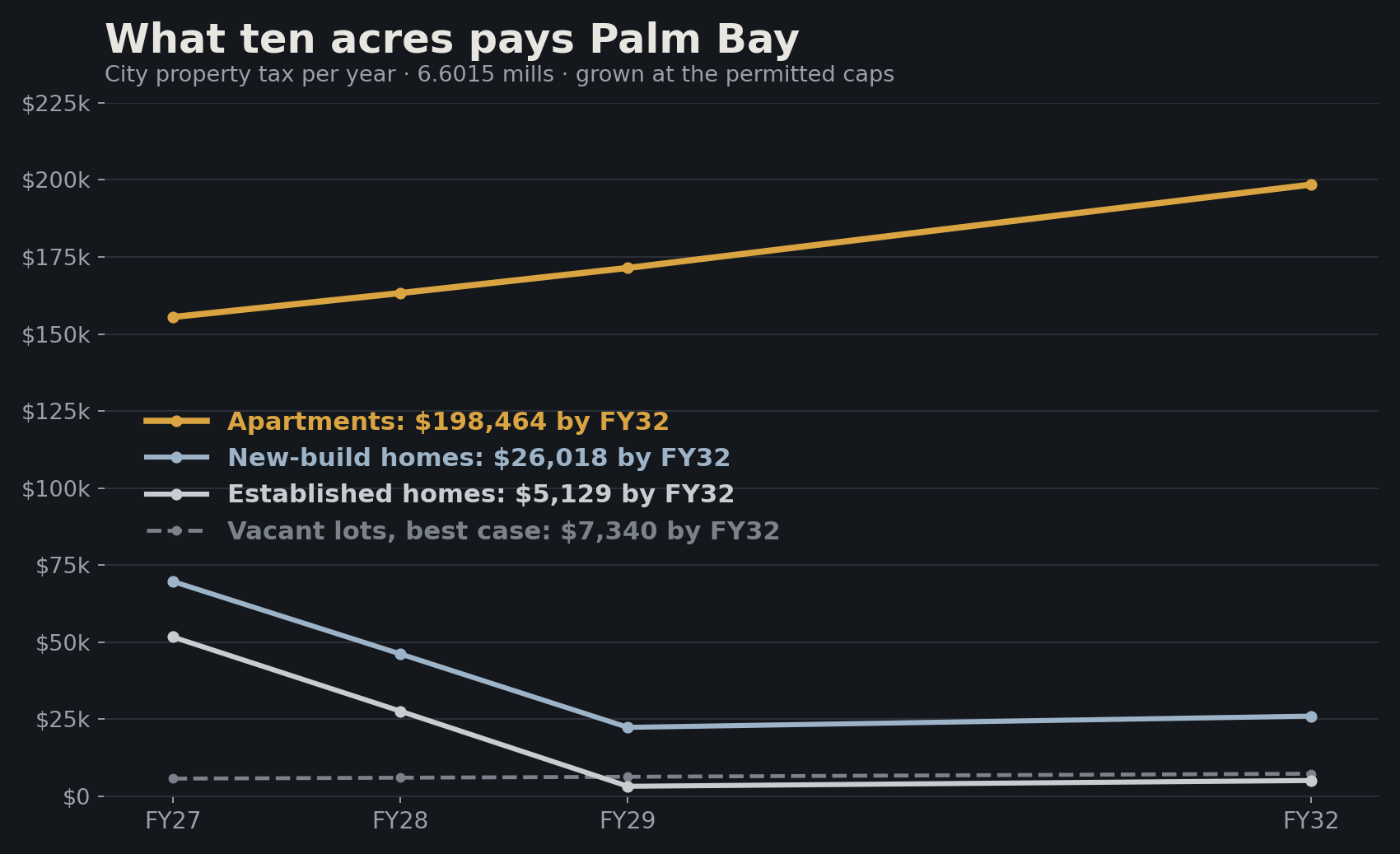
Palm Bay levies one operating rate, 6.6015 mills, on every parcel inside the city. The difference is who gets the exemption. This table shows what ten acres yields to the general fund under each use. The figures come from certified 2026 Brevard Property Appraiser records for real parcels along the Parkway corridor, and they are not frozen at today's values. Each class of property is grown forward at the maximum its cap permits: homestead assessments at the 3 percent Save Our Homes cap, non-homestead assessments at the new 5 percent cap, and the exemption along the state's own inflation path ($150,000 in FY28, $250,000 in FY29, $267,231 by FY32). That is the growth case least favorable to my argument, because it lets homesteaded homes pay as much as the law allows. Both single-family medians are shown so the low row can't be called cherry-picked.
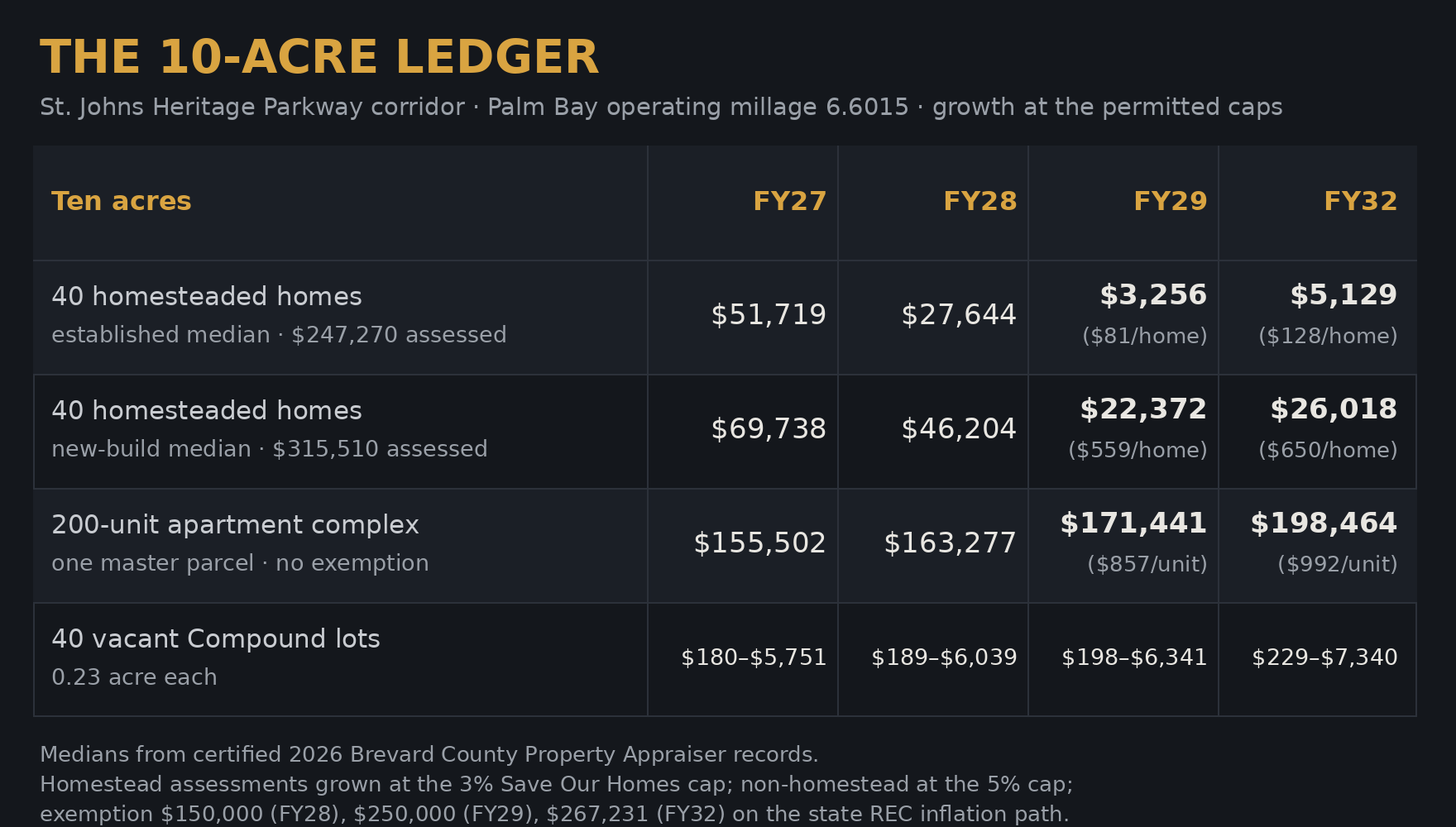
This table is the new constitution of Palm Bay land use. It will be just as true in 2029 and 2032 as it is today.
Here is how to read it.
Forty established homes pay $51,719 today. Even growing at the full 3 percent the law permits, the $250,000 exemption swallows nearly all of it: $3,256 in FY29, about $81 a house. By FY32 the bill creeps back to $128 a house as 3 percent compounding inches past the inflation-indexed exemption, and that is still under a tenth of the $1,293 those homes pay today. If assessments instead grow at the state's forecast inflation of about 2.2 percent, the FY29 figure falls to about $55 a house. Either way, it rounds to nothing.
Forty new-build homes pay $69,738 today and $22,372 in FY29, about $559 a house, down 68 percent. Their bill bottoms out there and then climbs slowly, to $650 a house by FY32, because a 3 percent assessment cap compounds faster than an inflation-indexed exemption. The direction never reverses. The gap just stops shrinking and starts, dollar by dollar, growing on the other side.
Two hundred apartments on one master parcel pay $155,502 today, $171,441 in FY29, and $198,464 in FY32, growing at the 5 percent non-homestead cap. In FY29 that is about 7.7 times what the forty new-build homes pay, and because the apartment row compounds at 5 percent while the homestead rows are being eaten by the exemption, the dollar gap widens every single year: about $149,000 in FY29, about $172,000 by FY32.
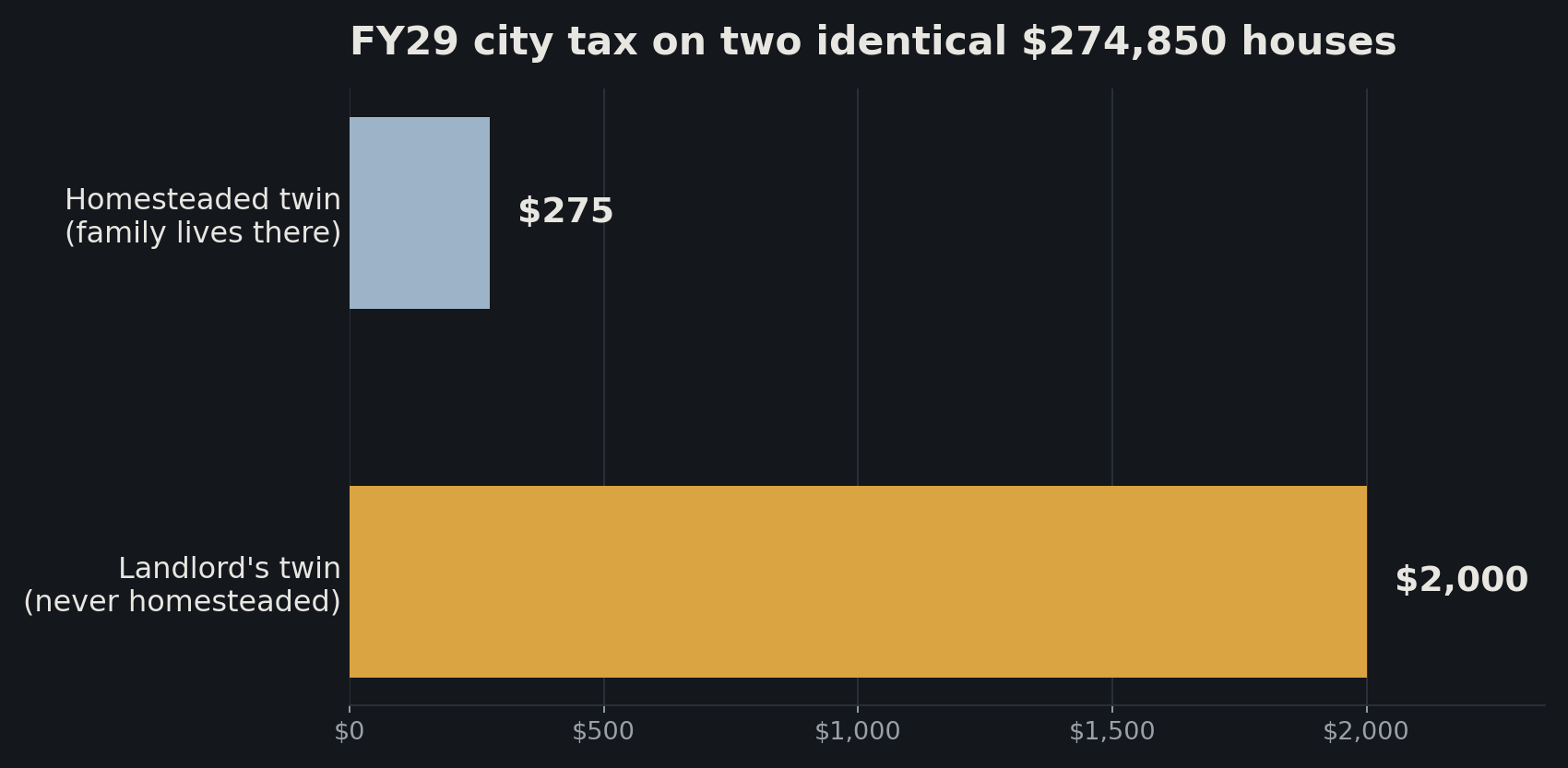
Picture two identical houses side by side on a Palm Bay street, each assessed at $274,850 today. One is owned by the family that lives in it. In FY29 it pays the city about $275. The other is owned by a landlord partnership, so it can never be homesteaded. It pays about $1,814 today and about $2,000 by FY29. Same street, same services, same police cars driving by.
What vacant lots do and don't do
The easy assumption is that vacant lots are all upside: tax collected, no service calls. The records don't support that as a rescue.
A long-held 0.23-acre lot in Port Malabar Unit 51 carries $10,500 in market value but only $680 in taxable value, because of the non-homestead assessment cap. It pays $4.49 a year. A Unit 49 lot taxed on $6,450 pays $42.58. One that sold and reset to $21,780 pays $143.78. Forty lots on ten acres pay $180 to $5,751 a year.
A vacant lot costs the city little to serve, so I'm not calling it a drain. I'm saying it can't carry a budget. Morton told the council on November 5 that road costs went from $1 million to $5 million a mile since COVID. At $4.49 a lot, nobody is repaving anything.
A vacant lot that becomes a homesteaded house can go from a few dollars a year to zero. The police, fire, and road obligations arrive anyway.
The wall
The usual answer is that the city will move the cost off the general fund with special assessments, a community development district, or a homeowners association. Some of that works.
A Chapter 190 district is an independent special district, and its maintenance assessments are not the city's. Palm Bay Charter Section 6.02 doesn't reach them. It reads: "Before the governing body for the city may levy any special assessment involving more than fifty (50) property owners or involving a project expenditure of greater than twenty-five thousand dollars ($25,000.00), the proposed assessment must first be approved, in writing, by a majority vote of the affected property owners who return a ballot."
Palm Bay's own development agreements already hand internal ponds and landscaping to master associations. My research found no Florida example of a city requiring a CDD or a perpetual MSBU covenant as a condition of a residential development agreement. That doesn't make it illegal. It makes it untested, and a city-levied MSBU would still run into Section 6.02.
Here is the part no structure fixes. Florida's test for a special assessment comes from City of Boca Raton v. State, 595 So. 2d 25 (Fla. 1992). The service has to give the assessed property a special benefit, and the charge has to be fairly apportioned. Fire protection passes. So do stormwater, solid waste, and local subdivision streets and lights. Police does not. In Lake County v. Water Oak Management Corp., 695 So. 2d 667, 670 (Fla. 1997), the Florida Supreme Court wrote: "Clearly, services such as general law enforcement activities, the provision of courts, and indigent health care are functions required for an organized society and are not services that confer a 'special benefit' upon land."
Collier County v. State, 733 So. 2d 1012 (Fla. 1999), struck down a charge built to push sheriff and general government costs onto new development. City of North Lauderdale v. SMM Properties, 825 So. 2d 343 (Fla. 2002), put emergency medical transport on the same side of the line. Palm Bay has its own entry in the series. In Hanna v. City of Palm Bay, 579 So. 2d 320 (Fla. 5th DCA 1991), the city lost when it tried to assess routine street resurfacing.
A district can't escape the wall either. Section 190.012(2)(d), Florida Statutes, says a district "may not exercise any police power." An HOA can hire extra patrol hours with its own dues. That is an add-on. It doesn't replace the baseline coverage the general fund provides.
So every new homesteaded home carries a police and EMS cost that no assessment, district, or covenant can legally move off the general fund.
Palm Bay's FY27 budget has $40.9 million for Police and $35.7 million for Fire Rescue. Together that is $76.58 million, 56 percent of the general fund. It is more than the $70.48 million the operating levy raises. Spread over roughly 52,000 to 55,000 households, it is about $1,400 a household. That is my division, an average and not a marginal cost, and the city has never published a marginal one. Even so, $432 doesn't cover it, and zero doesn't either.
Who pays uncapped 100 percent taxable value now
The certified 2026 roll inside city limits shows at least 1,796 corporate-owned single-family parcels. Of those, 1,505 are built rental homes and 291 are vacant platted lots held by land banks. The owners include Invitation Homes entities (482 parcels), FirstKey and Cerberus entities (384), Amherst and Main Street Renewal (277), Progress and Pretium (187), and CAH (132). Every one carries a $0 homestead exemption. That count comes from owner-name searches of known platforms, so it is a floor.
Some of it is brand new. Invitation Homes entities built 164 homes in 2024 and 2025 in Port Malabar Unit 44. A FirstKey entity, FKH SFR Q LP, built 59 in 2025 and 2026 on lots that carried a $29,500 market value as vacant land. Those lots were platted decades ago, so no rezoning was needed.
Take one of the Invitation Homes houses, assessed at $274,850. Owned by an LP, it pays the city about $1,814 a year at 6.6015 mills, rising to about $2,000 by FY29 at the 5 percent cap. Owned by a family with a homestead, the same house pays about $275 in FY29. Same street, same services. The landlord's bill gets built into the rent.
One exhibit shows the model at scale. Havens at Palm Bay Reserve, at Malabar Road SW and the future Parkway extension, is 266 single-story rental homes on 26.6 acres. It sits on one master parcel (Account 2903874) owned by MALABAR PO LLC. To a driver it looks like a villa neighborhood. To the tax roll it is one account with no homestead exemption, and none of the 266 can ever claim one. The 2026 roll still values the parcel as land ($1.596 million), and the buildings come on as certificates of occupancy issue. I'm not putting a tax figure on it until the roll catches up.
Counting the 266, that makes 2,062 institutional rental homes and lots in the city. Of those, 1,771 are homes and 291 are vacant lots.
For years, politicians ran against Wall Street landlords. Amendment 3 just made them City Hall's best friends.
What the docket shows
Emerald Lakes East Phase 1 got its final development plan on October 15, 2026, 4-0. It got DA26-00001 on November 5, 5-0. The mix is 652 apartments and 1,106,700 square feet of non-residential space, including a 400-room hotel. There are no single-family homes on that tract. The single-family product in that development sits on other tracts under other approvals.
It was entitled that way before voters acted on Amendment 3, so I'm not claiming a reaction. I'm showing what the favorable mix looks like on paper.
One vote proves nothing, and I'm not claiming motive. Nobody on a dais will announce they're done approving homesteaded subdivisions. A council can weigh housing, jobs, and neighbors' wishes against the arithmetic. From now on it does that with the arithmetic in view, or without it.
The council can't zone a lot "no homesteads." Platted lots build by right, for an owner or a landlord. The levers are the discretionary ones: future land use changes, rezonings, planned unit developments, annexations, and development agreements. In those decisions the council chooses what to entitle, and the model above applies every time.
The standing question
I'm looking for solutions, so here is one that costs nothing. Every legislative memo that goes to the Planning and Zoning Board or the council already has a FISCAL IMPACT line. The city could fill it in, in dollars per year, whenever homesteadable lots are involved. That means tax revenue at the scheduled exemption, plus police, fire, and road cost at the city's own budget figures. The city could also publish a marginal service cost per household, which it has never done. Without those numbers the council votes on one side of the ledger.
Has the city run a post-Amendment 3 net fiscal impact model on the homesteaded homes in this application, and how many dollars a year will the general fund lose to serve them once the exemption reaches its scheduled level?
That question belongs on every application with homesteadable lots, in 2026, in 2029, and in any year the exemption schedule or the charter cap changes. The next place it gets asked is the Planning and Zoning Board on December 2, 2026, and the council on January 7, 2027, when Three Forks brings 376 single-family lots back to the dais. In the November 5 packet, the FISCAL IMPACT line on that development agreement's cover memo was blank.